The Emperor sits square on a grey stone throne carved with four ram heads, wearing red robes with a suit of armour showing at his legs and arms. In his right hand he holds an ankh sceptre, in his left a golden orb, and his beard is long and white. Behind him rise bare orange mountains with a thin river running at their base, the only living water in the picture. He is not resting: he is holding a position, and that is the card's whole subject.
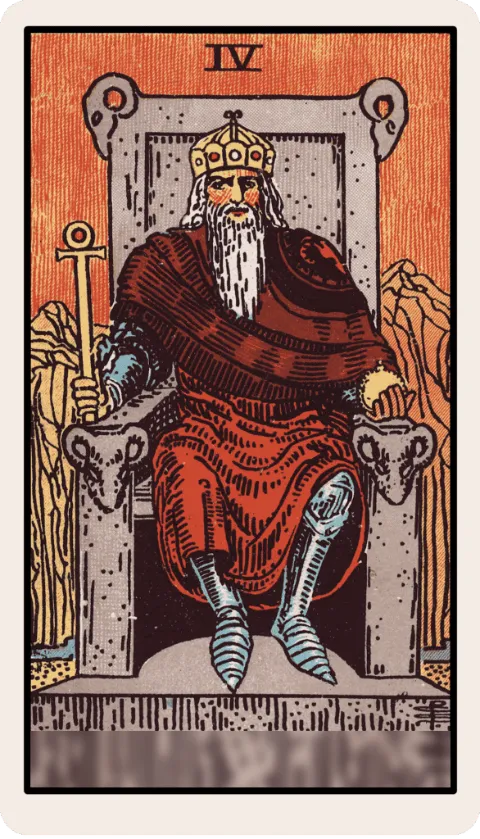
The Emperor in a nutshell
- Number: IV, the fourth card of the major arcana.
- Upright: authority, structure, protection, rules that hold, a plan someone actually enforces.
- Reversed: control for its own sake, rigidity, a weak or absent authority figure.
- Element and planet: Fire, ruled by Aries and its planet Mars.
- Yes or no: yes, on the condition that you organise it and commit to the structure.
The Emperor upright meaning
Upright, The Emperor is the card of the frame around the thing. Where The Empress grows, he decides how much, by when, and who is responsible. He turns up when a situation needs a decision more than it needs more feeling: set the budget, name the deadline, write the rule down, tell the person no. His mountains are barren for a reason, this is order applied to hard ground.
He often describes protection rather than domination. The Emperor is the boss who takes the blame publicly, the father who shows up, the contract that means you get paid. If he lands in a reading about chaos, he is saying the chaos ends when somebody takes charge, and that the somebody is probably you.
The Emperor reversed
What changes when it comes out reversed
Reversed, the structure stops serving anyone. Rules multiply, exceptions vanish, and a system that was built to protect people is now mostly protecting itself. This is the micromanaging manager, the parent who confuses obedience with respect, the plan you defend long after the facts changed. Stubbornness reads as strength from the inside and as fear from the outside.
The opposite reading is just as common: no authority at all. Nobody is holding the boundary, decisions drift, and the person who should be in charge has quietly left the room. In a self-reading he can point to a difficult relationship with your father, or to your own reluctance to take a position and defend it.
The Emperor in love
Upright in a love reading, The Emperor is commitment with terms. He describes a partner who is loyal, steady and a little formal, someone who says what they will do and then does it, and who shows love through provision rather than through poetry. For a couple he can mark the moment things become official: moving in, marriage, a shared account, a plan you both sign off on.
Reversed, that steadiness hardens. One person makes all the decisions, the relationship runs on rules that were never negotiated, and affection arrives conditionally. It can also mean a partner who is emotionally unavailable behind a wall of work and duty, or a bond where you keep waiting for permission to want something.
The Emperor in work and money
At work this is the promotion, the founder role, the project that finally gets a proper owner. He rewards systems: written processes, clear reporting lines, a plan with dates on it. With money he favours discipline, a real budget, debts paid on a schedule, savings that are not touched. Reversed, expect a controlling boss, a rigid organisation, or finances squeezed by inflexible commitments you signed too early.
How to read The Emperor in a spread
In the past he is usually the rule you grew up under, or an authority figure whose voice you still hear. In the present he asks what structure the situation is missing. In the future he promises stability, though the price is commitment. Next to The Empress he is the classic pairing of order and care, strong for a household or a partnership. Next to The Tower, the structure he built is the thing about to be tested. Alongside the Eight of Pentacles he reads as steady craft turning into a career.
Frequently asked questions
Is The Emperor a yes or a no?
A conditional yes. He agrees with plans that have structure behind them and disagrees with anything improvised. If your question is about starting something without a timeline, a budget or a person in charge, read him as a not yet rather than a no.
What does The Emperor mean as the card of the day?
It is a day for decisions and admin, the tasks that need a spine rather than inspiration. Answer the difficult email, set the boundary you have been avoiding, put the numbers in a spreadsheet. Days under The Emperor go well when you are direct and badly when you hedge.
Does The Emperor represent a person?
Frequently: a father, a boss, a lawyer, an older man with real authority over the situation, or anyone whose approval unlocks what you want. He can also be an institution rather than an individual, a bank or a court, and sometimes the version of you that already knows what needs to be decided.
Keep learning
Previous card: The Empress. Next: The Hierophant. You can also browse the full card index or pull your tarot card of the day.
Is The Emperor your card? Find out whether it is your tarot birth card or your 2027 tarot year card: both calculators are free and take a second.
Tarot Vera Luna is an entertainment site: no reading replaces medical, legal, financial or psychological advice. Read this card in Spanish.