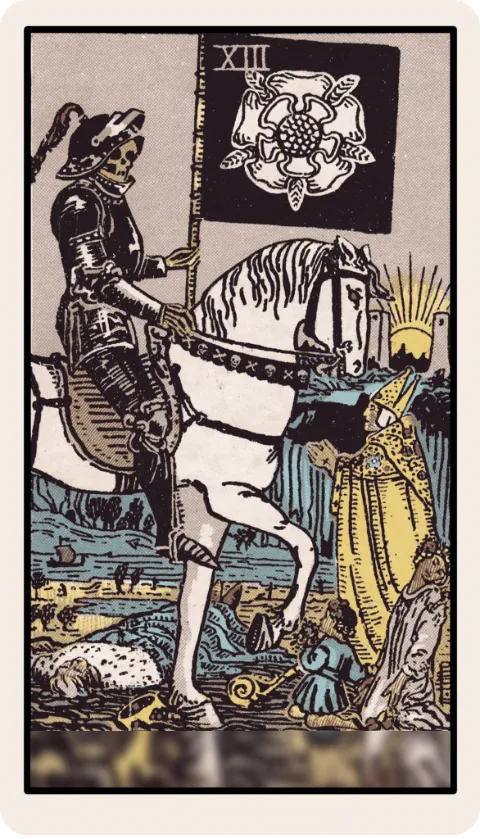
In the Rider-Waite-Smith deck, Death rides a white horse in black armour and carries a black banner with a white five-petalled rose. A king lies fallen under the hooves while a bishop, a young woman and a child meet the rider in three very different ways. Behind them a river runs toward two towers, and the sun is coming up between them. The card is about an ending that clears ground, not about a literal death.
Death in a nutshell
- Number: XIII, the thirteenth major arcana.
- Upright: a chapter closes, change that will not reverse, room for what comes next.
- Reversed: resisting the ending, dragging out something already over.
- Element and planet: Water, ruled by Scorpio and its modern regent Pluto.
- Yes or no: not a plain yes. Yes to change, no to keeping things as they are.
Death upright meaning
Death upright draws a line. Something has run its course, a job, a version of a relationship, a way of seeing yourself, and the return ticket has expired. The skeleton is a reaper rather than an executioner: it takes the harvest when the harvest is ready. The figures in the image show the usual reactions. The king resists and falls anyway, the bishop negotiates, the woman looks away, and only the child looks straight at the rider.
What makes the card useful is the direction it points. Everything it touches gets simpler. Habits that cost a lot of effort to maintain start falling away on their own. When it turns up you are usually not being asked to decide anything, you are being asked to notice what has already ended and stop paying rent on it. The rose on the banner carries that: five petals, an old sign of life renewing, printed on black cloth.
Death reversed
What changes when it comes out reversed
Reversed, the movement stalls. Same ending, except you are holding the door open. It looks like keeping in touch with someone you already said goodbye to, staying three months longer in a job you left mentally in spring, or telling the story of who you used to be in the present tense. Nothing dramatic happens. It simply costs energy that has nowhere to go.
It can also mean the ending is under way quietly and you have not put it into words yet. Read the neighbours. Beside Swords the resistance is mental, you are arguing with a fact. Beside Cups it is affection keeping you tied. Beside Pentacles it is practical: a shared lease, a contract, something that makes leaving expensive.
Death in love
Upright in a love reading, Death rarely means a breakup on its own. It means the relationship cannot continue in its current shape. Couples pull this card when they move in together, when children arrive, when one of them changes career, when an old dynamic finally stops working. For someone single it often marks the moment a type you always went for stops being attractive.
Reversed, it points to a goodbye that never got said properly: an ex still in the group chat, a relationship running on habit and shared history, a profile that keeps getting checked. The card is not scolding anyone. It is saying the attachment is doing the work the decision should be doing.
Death in work and money
At work, Death is restructuring: a role that disappears, a client that leaves, a project quietly shelved, a company reorganising around you. Upright it usually turns out to be the push you needed, and the timing is not yours. Reversed it drags, like the layoff that keeps being announced and never lands, or the freelancer keeping a bad client out of loyalty. With money the card favours clearing over starting: cancel the subscriptions, settle the debt, close the account you never use.
How to read Death in a spread
Position changes a lot. In the past, Death is an ending you already lived through and the reading is about what grew there. In the present it is happening now, and the useful question is what you are still carrying. In the future it is a change on the way, usually welcome once it lands. Watch the combinations: with The Tower the ending is sudden and external rather than gradual. Followed by Temperance the message is recovery and rebalancing, which is exactly the order the major arcana puts them in. With the Ten of Swords the ending is already over and the card is asking you to stand up. With The Sun, what comes next is plainly better than what went.
Frequently asked questions
Is Death a good card or a bad card?
Neither, and it is one of the least literal cards in the deck. Death does not predict illness or a death in the family, and no careful reader will tell you it does. It describes a transformation: something ends and something else becomes possible. Most people who draw it feel relieved about it a month later.
What does Death mean as the card of the day?
A day for closing rather than opening. Send the message that ends the thread, delete the draft, return the thing you borrowed, have the conversation you keep postponing. Avoid starting anything big. By the evening, notice what you feel lighter without.
Does Death represent a person?
Sometimes, and rarely flatteringly. It can be whoever shows up at the end of a cycle: the person who tells you the truth, the manager who cuts the project, the friend who moves away. In flavour the tradition links it to Scorpio, so think intense, private, hard to read, no small talk.
Keep learning
Previous card: The Hanged Man. Next: Temperance. You can also browse the full tarot card index or pull your tarot card of the day.
Is Death your card? Find out whether it is your tarot birth card or your 2027 tarot year card: both calculators are free and take a second.
Tarot Vera Luna is an entertainment site: no reading replaces medical, legal, financial or psychological advice. Read this card in Spanish.