The Hierophant sits between two grey stone pillars in red vestments and a triple crown, one hand raised in blessing with two fingers up, the other holding a cross with three bars. Two tonsured acolytes kneel below him, their robes embroidered with roses and lilies, waiting to be taught. A pair of crossed keys lies on the floor between them. Everything happens indoors, inside an institution, and that setting is the point: this is knowledge that is handed down rather than discovered alone.
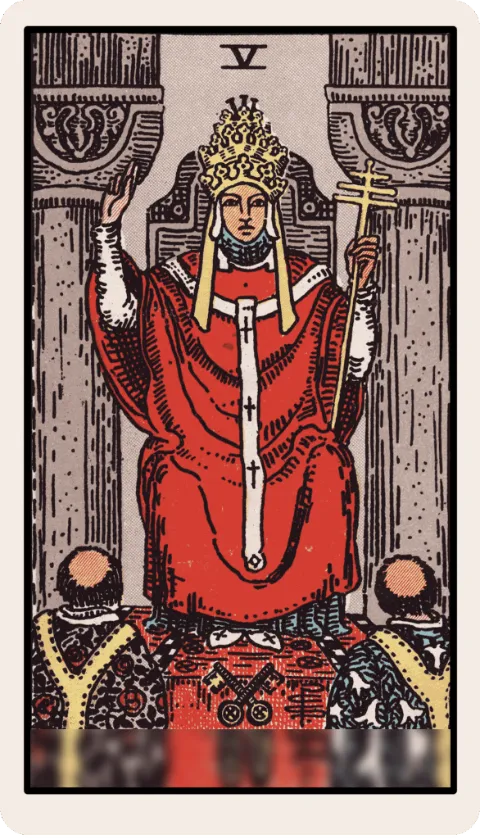
The Hierophant in a nutshell
- Number: V, the fifth card of the major arcana.
- Upright: tradition, teaching, mentorship, belonging to a group, doing it the established way.
- Reversed: breaking with convention, dogma that no longer fits, a teacher who lost your trust.
- Element and planet: Earth, ruled by Taurus and its planet Venus.
- Yes or no: yes if you follow the accepted route, no if the plan depends on cutting corners.
The Hierophant upright meaning
Upright, The Hierophant says there is a method and someone already knows it. He points to formal learning, apprenticeship, certification, therapy with an actual therapist, the course rather than the internet. When people are stuck reinventing something that was solved decades ago, he is the card that says go and ask, then do the boring version properly before you improvise.
He is also about belonging. Families, religions, professions and workplaces all run on shared rules, and this card describes the comfort and the cost of signing up to a set of them. In a good reading he brings a mentor, a community that has your back, or a ceremony that makes something official in front of witnesses.
The Hierophant reversed
What changes when it comes out reversed
Reversed, the tradition stops fitting. You have outgrown the institution, the faith, the family script or the industry standard, and continuing to obey it costs more than leaving. This is the person who quits the career their parents chose, or who stops attending something out of habit. The card does not promise the break will be comfortable, only that it is honest.
The darker reading is authority abusing its position: a teacher who keeps students dependent, a group that punishes questions, advice given for the adviser's benefit. It can also flag empty ritual, going through the motions of a job, a marriage or a belief you no longer hold. Ask whether the rule protects anyone, or only the person enforcing it.
The Hierophant in love
Upright in a love reading, this is a conventional relationship in the best sense: publicly acknowledged, approved by the families, headed towards or already inside a formal commitment. It favours shared values over chemistry, couples who want the same things about money, children and where to live. For someone single, it can mean meeting a partner through a group, a class, a church or a mutual circle.
Reversed, it is the relationship that does not fit the mould, and the pressure that comes with that: disapproving relatives, a partner your community does not accept, or a couple quietly choosing not to marry. It also describes two people running on autopilot, keeping the shape of a relationship after the substance has drifted away.
The Hierophant in work and money
At work he favours large, structured organisations: universities, hospitals, banks, public administration, anywhere seniority and qualifications matter. He supports training, exams and accreditation, and suggests that the credential really will open the door. With money he is conservative and effective: pensions, insurance, advice from a professional rather than a forum. Reversed, expect friction with company culture, or a qualification that turns out to be worth less than the work itself.
How to read The Hierophant in a spread
In the past he is the upbringing, school or faith that shaped your assumptions. In the present he asks who you are learning from and whether you trust them. In the future he points to a qualification, a wedding or joining something formal. Next to The Lovers he sharpens into a question about commitment on other people's terms. With the Eight of Pentacles he is straightforward apprenticeship, skill learned under supervision. Beside The Tower, the institution itself is the thing about to give way.
Frequently asked questions
Is The Hierophant a good card or a bad card?
Neither, and that is unusual for the majors. He is good news if you want stability, recognition and a clear path, and bad news if you want freedom, because his help always comes attached to somebody else's rules. Read the surrounding cards to see which of those you are actually asking about.
What does The Hierophant mean as the card of the day?
A day for doing things by the book. Read the manual, take the meeting with the person who has done this before, file the paperwork you have been putting off. It also rewards teaching: if someone asks you how something works, explain it properly instead of doing it for them.
Does The Hierophant represent a person?
Usually a teacher, mentor, therapist, priest or senior colleague, someone older whose approval carries weight in your field. He can also stand for an institution instead of a person, a university or a professional body, and occasionally for the inherited voice in your head that still tells you what is done and what is not.
Keep learning
Previous card: The Emperor. Next: The Lovers. You can also browse the full card index or pull your tarot card of the day.
Is The Hierophant your card? Find out whether it is your tarot birth card or your 2027 tarot year card: both calculators are free and take a second.
Tarot Vera Luna is an entertainment site: no reading replaces medical, legal, financial or psychological advice. Read this card in Spanish.