A crowned figure in a red robe sits between two grey pillars, a purple veil drawn across the gap behind. The right hand holds a double-edged sword straight up, the left holds a set of scales already in balance, and one small white shoe shows under the hem. There is no blindfold here, unlike the statue outside a courthouse. Justice looks straight at you and weighs what it sees.
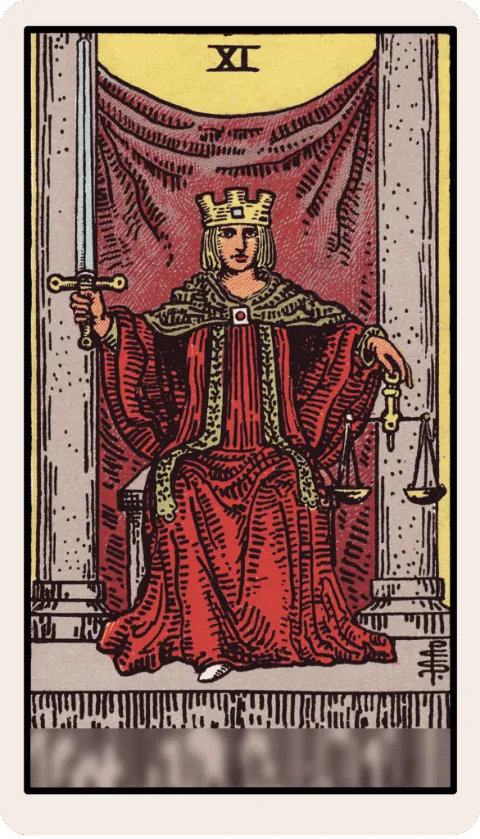
Justice in a nutshell
- Number: eleven of the major arcana, XI in the Rider-Waite-Smith order, where it swaps places with Strength.
- Upright: cause and effect, fairness, a decision made on the facts, contracts and legal matters.
- Reversed: bias, an unbalanced deal, responsibility dodged, a case that drags on.
- Element and planet: air, ruled by Libra.
- Yes or no: yes if you have been fair, no if you have not.
Justice upright meaning
Upright, Justice is the card of results that match inputs. Something is being decided, and it will be decided on the record rather than on how strongly you feel about it. That is good news if you have done the work and kept your side clean, and uncomfortable if you have been cutting corners and hoping nobody counted.
Practically it often shows up as paperwork with consequences: a contract, a tax return, a custody arrangement, a formal complaint, a settlement. It also marks the moment you finally see a situation clearly, without the story you had been telling yourself about it. The sword points up because clarity comes before the ruling, and the ruling is usually one you can predict once you are honest about the facts.
Justice reversed
What changes when it comes out reversed
Reversed, the scales tip. Somebody is getting more than they gave, and it may well be you. Look at the arrangements you have stopped examining: the friend you always drive, the role you took on temporarily two years ago, the invoice you keep discounting. Nothing here is dramatic, which is exactly why it has run so long.
The harder version is accountability avoided. You know the part you played and you have built a good argument for why it does not count. Justice reversed does not punish, it simply keeps the total. In legal or administrative questions it points to delays, a technicality, an outcome that is correct on paper and wrong in the room. If a document is involved, read it again before signing.
Justice in love
In love, Justice upright is the card of an honest reckoning. It suits the conversation where both people finally say what they need, and it favours relationships built on clear agreements rather than assumptions. For long couples it can mean marriage, a shared mortgage, or the legal side of building a life together. It also rewards anyone who has been consistently decent: that record is about to matter.
Reversed in love, the effort is lopsided. One person plans, remembers, apologises and repairs, and the other arrives. It can also flag a truth being withheld, or a separation where the terms are unfair. If you are single, it asks whether you judge new people on evidence or on the first ten minutes.
Justice in work and money
At work, Justice upright favours reviews, appraisals, audits and any process with written criteria, because criteria are where you do well. It is a strong card for law, accountancy, HR, compliance and mediation, and it supports asking for the raise you can document. On money it means balancing the books literally: check the subscriptions, the interest rate, what you actually earn per hour on that side project. Reversed, it warns of a contract skewed against you, a fine or penalty catching up, and any deal explained verbally that nobody wants to put in writing.
How to read Justice in a spread
In the past position it marks a decision or a formal process that still sets the terms of today, often a divorce, a settlement or a contract signed years ago. In the present it says the facts are already known and the ruling is close. In the future it promises a fair outcome rather than a generous one. Next to the Devil it exposes the small print in a binding arrangement. With Judgement it becomes a formal verdict, frequently one you appealed for. Beside the Seven of Swords something concealed comes to light, and the timing rarely suits the person who concealed it.
Frequently asked questions
Is Justice a good card or a bad card?
Neither, and that is the point. Justice returns what the situation has earned, so it feels excellent when you have been straight and unpleasant when you have not. In readings about disputes it is one of the few cards that genuinely answers the question rather than describing the mood around it.
What does Justice mean as the card of the day?
A day for admin with teeth: the form, the reply you have drafted three times, the number you have avoided checking. Decisions made today hold, so make them on evidence rather than mood, and keep a copy of anything you send.
Does Justice represent a person?
Yes, and often a literal one: a lawyer, a judge, an auditor, a manager running your review, frequently a Libra. In personal terms it describes someone even-handed and hard to sway, the friend whose opinion you ask precisely because they will not flatter you. Reversed, someone who has already picked a side.
Keep learning
Previous card: Wheel of Fortune. Next: The Hanged Man. You can also browse the full tarot card index or pull your tarot card of the day.
Is Justice your card? Find out whether it is your tarot birth card or your 2027 tarot year card: both calculators are free and take a second.
Tarot Vera Luna is an entertainment site: no reading replaces medical, legal, financial or psychological advice. Read this card in Spanish.