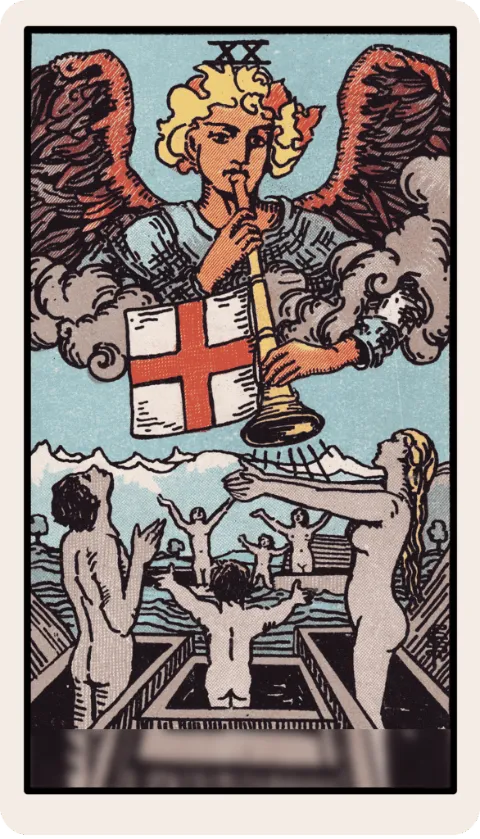
In the Rider-Waite-Smith deck, Judgement shows the angel Gabriel leaning out of a bank of cloud and blowing a trumpet hung with a square banner marked by a red cross. Below, grey figures rise from open coffins floating on water: a man, a woman, and a child between them with his back to us, all of them with their arms lifted and their faces turned up. Snow covered mountains close the horizon. Nobody in this picture is being punished, they are being called, and the card is about the moment you hear your own name.
Judgement in a nutshell
- Number: XX, the twentieth major arcana.
- Upright: awakening, a clear call, honest review of the past, second chances.
- Reversed: ignoring the call, harsh self criticism, a decision left hanging.
- Element and planet: fire rising out of water, ruled by Pluto.
- Yes or no: yes, provided you are willing to answer and then act on it.
Judgement upright meaning
Upright, Judgement is the card of realising something you cannot unrealise. A sentence someone says in passing, a photograph, a medical result, a number in a spreadsheet: something small arrives and rearranges how you see the last five years. What follows is not drama but clarity, and usually a decision that has been waiting a long time for permission.
It also governs honest accounting. This is the point in the deck where you look back at what you built, name what worked and what you would not repeat, and forgive whatever needs forgiving so it stops costing you. Old chapters reopen here: a message from someone you lost touch with, a course you abandoned, a city you left. The card says the door is genuinely still open, but that answering it is your move, not the angel's.
Judgement reversed
What changes when it comes out reversed
Reversed, the call is heard and not answered. You know what the honest choice is, and you keep finding reasonable arguments for waiting: next quarter, after the holidays, once things calm down. The situation rarely collapses, it just stays exactly where it is while the discomfort quietly grows.
The second reading is judgement turned inward and sharpened. Here the review of the past becomes a prosecution: every old mistake recited, no allowance made for who you were at the time. It can also appear as being on the receiving end of someone else's verdict, family opinion or gossip that has already decided who you are. Either way the instruction is the same, swap the sentence for a fair account.
Judgement in love
Upright in love, Judgement brings the honest conversation. A couple finally names the thing they have circled for months, and the relationship either steps up a level or ends cleanly, with both people clearer than they were. It is also the classic reunion card: an ex who returns with something real to say, or a friendship repaired after years of silence. Reunions here only work when the reason for the break has actually been addressed.
Reversed, the conversation gets postponed again, or one person keeps reopening an old offence rather than settling it. For single readers it often shows a pattern you can now see plainly, choosing unavailable people, for example, at the stage where seeing it is not yet the same as changing it.
Judgement in work and money
At work Judgement covers reviews, results and turning points: an evaluation, an audit, an application answered, a role you realise you have outgrown. Many readers get it when a vocation starts pulling harder than the salary, right before a career change that colleagues describe as sudden and the reader knows was years in the making. In money it favours facing the numbers directly, checking what a subscription really costs across a year, or dealing with the debt you have been rounding down in your head. Reversed, the decision drifts and the reckoning simply arrives later.
How to read Judgement in a spread
In a past position it marks the turning point that explains the present, the moment you woke up to something. In the present it says the information is already in your hands, so the only question left is what you do with it. In the future it promises a call you will not be able to unhear, often within weeks. With the Eight of Cups it reads as leaving for good, this time consciously. Beside the Three of Swords it is the honest post mortem after a painful ending. Next to The World it says the cycle closes properly, with nothing left unsaid.
Frequently asked questions
Is Judgement a good card or a bad card?
Good, though not comfortable. It brings clarity and a second chance, and both of those ask something of you. The only bad outcome in this card is hearing the call clearly and pretending you did not.
What does Judgement mean as the card of the day?
Expect news that reframes something, or a moment of recognition while doing something ordinary. A good day to reply to the message you have been avoiding, book the appointment, or reread what you wrote a year ago. Decisions made today tend to stick.
Does Judgement represent a person?
It usually points to someone from your past returning, or to a person whose job is to assess: a doctor, an examiner, a lawyer, a recruiter. It can also stand for a figure who tells you the truth plainly and changes your mind in one conversation.
Keep learning
Previous card: The Sun. Next card: The World. Browse the full tarot card index or pull your tarot card of the day.
Is Judgement your card? Find out whether it is your tarot birth card or your 2027 tarot year card: both calculators are free and take a second.
Tarot Vera Luna is an entertainment site: no reading replaces medical, legal, financial or psychological advice. Read this card in Spanish.