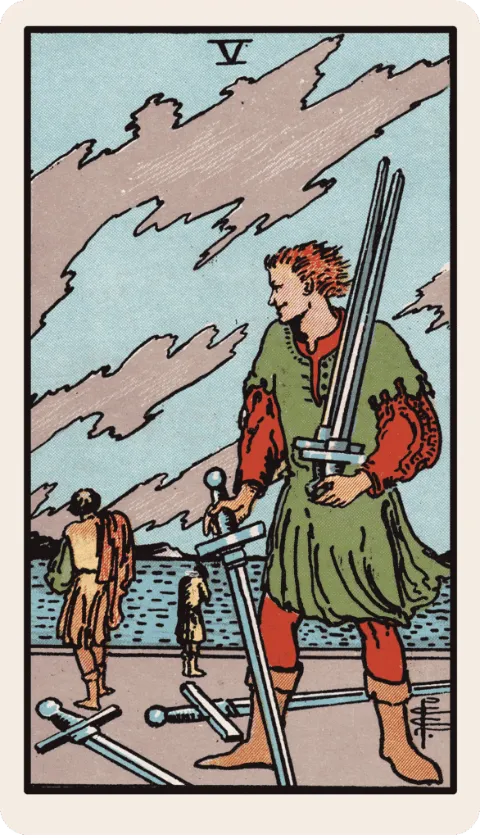
Under a sky of ragged, wind-torn clouds, a man gathers three swords into his arms and glances back with a half smile. Two more swords lie abandoned at his feet. Further off, two figures walk away toward a grey sea, shoulders down, one with a hand to his face. The battlefield is empty, the weather is turning, and the winner has no one left to tell.
Five of Swords in a nutshell
- Suit: swords, the suit of air, thought, language and truth.
- Upright: conflict, a hollow victory, ego in the room, winning at a cost.
- Reversed: cutting your losses, an apology, or a grudge that will not die.
- Element: air after an argument, sharp and cold.
- Yes or no: no, not on these terms.
Five of Swords upright meaning
Upright, the Five of Swords is a fight somebody won and everybody lost. The argument was taken personally, the point was proven, and the room emptied. Look at the picture honestly: the winner holds more swords than he can use on a field nobody wants anymore. The card asks the only question that matters here, which figure are you.
It covers the whole family of hollow victories: the argument won with the sentence you knew would hurt, the office battle that cost you an ally, the family quarrel where being right became more important than being close. Some conflicts are worth having, and swords people know it; this card is about the ones that were really about pride wearing the costume of principle.
Five of Swords reversed
What changes when it comes out reversed
Reversed, there are two exits from the field. The good one is release: you cut your losses, decline round two, offer or accept the apology, and discover how much energy the war was eating. The other exit is a loop, an old resentment replayed nightly, a feud kept warm long after everyone else went home. One is walking away; the other is walking in circles.
The test is embarrassingly simple: if you still rehearse comebacks in the shower for a conversation that ended weeks ago, you are still on the battlefield. Say the closing sentence once, to the person or to a page, and physically leave something behind, the group chat, the thread, the habit of checking their profile. Fields only empty when the last soldier goes.
Five of Swords in love
In love, upright, this card is scorekeeping, the silent tally of who apologised last and who sacrificed more. Arguments become tournaments, and warmth dies of administrative causes. It can also flag a partner who negotiates affection like combat, sharp remarks filed under honesty. Winning an argument against someone you love is a strange trophy; it always costs more than it weighs.
Reversed, there is a genuine chance to repair after a bad fight, but only if both people put the swords down at the same time. Apologise for your ten percent even if theirs is ninety; someone has to go first, and the card suggests it might as well be you. If the low blows are a pattern rather than a lapse, name the pattern out loud.
Five of Swords in work and money
At work this is the turf war, the credit quietly taken, the meeting where somebody had to be seen losing. You can win those games and still lose the room, because colleagues remember tone far longer than outcomes. Pick the two battles a year that genuinely matter and concede the rest with visible grace; it reads as strength because it is. With money, beware disputes where the legal fees outgrow the amount contested, and deals whose fine print requires an opponent. Sometimes the cheapest outcome is the settled one.
How to read Five of Swords in a spread
In the past position it is an old defeat or humiliation that still armours your reactions today. In the present it says de-escalate: the fight in front of you is optional. In the future it warns of brewing conflict, which is useful, because battles seen early can be declined. Next to the Six of Swords the message is to leave the battlefield entirely and let distance finish the argument. With The Tower the quarrel cracks something structural, so choose words as if they were permanent. Beside Justice the dispute may turn formal; document everything and stay polite.
Frequently asked questions
Is the Five of Swords a yes or a no?
A no. Whatever you would win on these terms would arrive damaged, and the card is blunt about it: the prize costs more than it pays. Change the terms or change the question. For a quick second opinion, try the yes or no tarot with a calmer framing.
What does the Five of Swords mean as the card of the day?
Friction is likely: a snippy email, a driver with a point to prove, a colleague spoiling for a debate. Your win condition today is not taking the bait. Say one sentence less than you want to, especially in writing, and let the small provocations expire unanswered. By evening you will be glad of every duel you skipped.
How do I know if the Five of Swords is about me?
Listen to the story you tell about the conflict. If every character in it is unreasonable except the narrator, the card is probably holding up a mirror rather than pointing out the window. Being the one collecting swords feels like winning from the inside; check the faces around you for the real score.
Keep learning
Previous card: Four of Swords. Next card: Six of Swords. You can also browse the full tarot card index or pull your tarot card of the day.
Tarot Vera Luna is an entertainment site: no reading replaces medical, legal, financial or psychological advice. Read this card in Spanish.