A ferryman stands at the stern of a small boat, poling it across wide grey water. A woman wrapped in a cloak sits with a child beside her, both facing the far shore, and six swords stand upright in the bow, travelling with them. The water on the right of the boat is choppy; ahead, toward the tree-lined shore, it turns smooth. Nobody looks back.
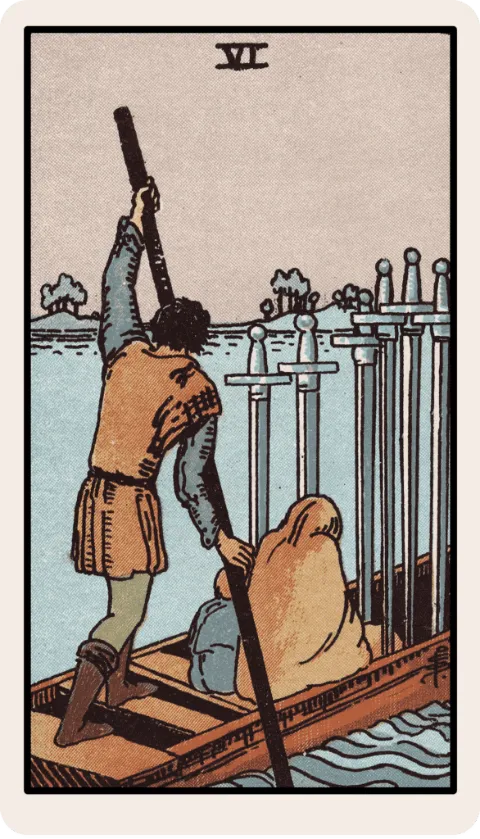
Six of Swords in a nutshell
- Suit: swords, the suit of air, thought, language and truth.
- Upright: transition, moving on, a quiet passage to calmer water.
- Reversed: a delayed departure, heavy baggage, the pull to turn back.
- Element: air over water, a steady crossing wind.
- Yes or no: yes, a gentle yes that improves with distance.
Six of Swords upright meaning
Upright, the Six of Swords is the unglamorous miracle of moving on. No fireworks, no triumphant music: just a boat, a ferryman, and the decision to be somewhere else. The swords come along because what you learned travels with you; the passengers sit low because leaving, even leaving something bad, is heavy. The promise is in the water itself, rough behind the boat and smooth ahead.
It appears when you change city, job, school or chapter, and just as often when the journey is internal: out of a hard season, away from an old identity, past a grief that finally loosened. The ferryman matters too: accepting help with the crossing, a friend, a professional, a colleague who has made the same trip, is part of the card, not a footnote to it.
Six of Swords reversed
What changes when it comes out reversed
Reversed, the boat is loaded and not moving. You know the crossing is due, everyone around you knows it, and still one foot stays on the dock: the familiar misery keeps outbidding the unfamiliar calm. It can also mark a trip or move genuinely postponed, or the boomerang return to a place, a job or a person you had already rowed away from once.
The reversal asks you to stop re-litigating the shore behind you. The argument with the past has been held a hundred times and produced nothing but wake. Book the thing, send the application, set the date; motion is the medicine here. And if you truly cannot leave yet, then stop mid-crossing debates and prepare the boat properly instead, so that when the water opens, you go.
Six of Swords in love
In love, upright, a relationship moves out of a stormy stretch into calmer water, often after real work: the fights lose their heat, the apologies start arriving on time, and the two of you become a crew instead of opponents. Sometimes it is the other crossing, the calm, adult departure from a bond that ran its course. If you are single, it marks healing distance from an ex, the heart quietly relocating to the present.
Reversed, it is the almost-left relationship, the bags packed twice a year and always unpacked, or the ex who reappears exactly when the water starts to smooth. Nostalgia is a skilled editor; it cuts every scene that made you leave. Decide from the whole film, not the trailer, and remember that the ferry will not wait forever.
Six of Swords in work and money
At work this card backs the transfer, the new role, the relocation, the handover done properly. Leave the old post the way the ferryman rows, steady and without drama, because industries are small lakes and reputations cross them fast. It also favours retraining: skills are swords that travel. With money, expect steadier water after a rough patch, and treat the costs of any move, deposits, courses, shipping, as investment rather than loss. Budget the crossing and it will pay for itself on the far shore.
How to read Six of Swords in a spread
In the past position it is the move, escape or rupture that brought you to where you sit now; respect what it cost. In the present it says keep rowing, you are mid-crossing and this is what progress feels like. In the future it promises improvement through a change of scene rather than a change of luck. Next to Death the departure is final and correct, a clean chapter break. With the Four of Swords the destination is rest itself, so plan a soft landing. Beside The Star the far shore is better than you currently believe.
Frequently asked questions
Is the Six of Swords a yes or a no?
A gentle yes. Things improve, but by increments and by distance rather than by lightning: expect better, not suddenly perfect. If the question is whether to go, the answer leans clearly toward the boat. For a sharper verdict on a specific question, use the yes or no tarot.
What does the Six of Swords mean as the card of the day?
A logistics day: bookings, applications, boxes, tickets, the unglamorous emails that move life forward. Do not expect fireworks; expect relief. One concrete step toward the thing you keep saying you will do counts double today, so buy the ticket or send the form before the mood passes.
Does the Six of Swords mean a physical move or a trip?
Often, yes. Of all the cards, this one most literally shows travel over water: a relocation, a journey, a visit that does you good, sometimes emigration. When no suitcase is involved, the trip is internal, out of one state of mind and into a quieter one, and it deserves the same careful packing.
Keep learning
Previous card: Five of Swords. Next card: Seven of Swords. You can also browse the full tarot card index or pull your tarot card of the day.
Tarot Vera Luna is an entertainment site: no reading replaces medical, legal, financial or psychological advice. Read this card in Spanish.