Under a flat yellow sky, a man tiptoes away from a camp of striped tents, five swords bundled awkwardly in his arms. Two swords stay planted in the ground behind him. He grins back over his shoulder at the camp he is robbing, while in the distance a small group stands around a fire, not yet aware. The theft is almost elegant, except he is carrying too much to run.
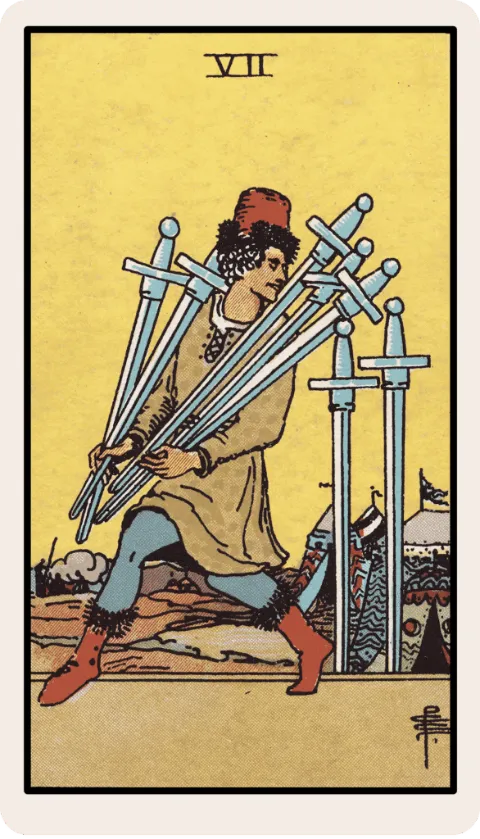
Seven of Swords in a nutshell
- Suit: swords, the suit of air, thought, language and truth.
- Upright: deception, strategy, acting alone, getting away with it.
- Reversed: a confession, getting caught, self-deception ending.
- Element: air, quick thinking on quiet feet.
- Yes or no: no, not while something stays hidden.
Seven of Swords upright meaning
Upright, the Seven of Swords is the card of the clever shortcut. Someone is not playing straight: information is being withheld, credit rerouted, a plan advanced sideways while the room looks elsewhere. Notice the comedy the illustration insists on. He has taken five swords, which is three more than he can carry well, and left two behind. Every scheme forgets something, usually the exit.
It is not always the villain card. Sometimes it blesses discretion: keeping a plan quiet until it is strong enough to survive opinions, leaving a hostile situation without a farewell tour, negotiating with cards held close. The question it asks is precise, who is missing information they deserve, and the answer decides whether this is strategy or theft. Swords always know the difference, even when their owner pretends not to.
Seven of Swords reversed
What changes when it comes out reversed
Reversed, the scheme runs out of breath. Secrets surface, the missing hours stop adding up, the borrowed idea is recognised in public. For the one carrying the swords, it often marks the moment the lie becomes heavier than the truth it was protecting, and confession starts to look like rest. Returns happen under this card: stolen credit given back, apologies delivered, accounts corrected.
It also covers self-deception ending, including the gentle kind: the impostor feeling that insists you stole a seat you actually earned. You did not tiptoe into your life; you built it. If suspicion of someone else brought you here, the reversal suggests the reveal is close, so resist the urge to play detective. Ask one direct question and watch the answer walk on tiptoe or on flat feet.
Seven of Swords in love
In love, upright, something is being carried out of the camp quietly: a flirtation kept in a separate folder, feelings edited before they are reported, a story with missing hours. It is not always an affair; more often it is the slow dishonesty of pretending to be fine. There is a difference between privacy and secrecy, and this card lives exactly on that border, glancing over its shoulder.
Reversed, the air clears, voluntarily or otherwise. The overdue conversation happens, the phone stops being guarded like a vault, and the relationship either survives the daylight or was only alive in the dark. Before assigning all the sneaking to your partner, audit your own camp: half-truths told to keep the peace are still swords leaving the tent under a coat.
Seven of Swords in work and money
At work this is the card of office politics played in the corridor: ideas repeated without their author, plans shared on a need-to-know basis where you apparently had no need, allies who take notes. Protect your drafts, put agreements in writing, and let documentation do the arguing. Strategy is legitimate; fraud is not, and careers rarely survive the discovery of the second dressed as the first. With money, read every contract twice and be slowest exactly where the offer is most in a hurry; too-good deals are usually carrying five swords.
How to read Seven of Swords in a spread
In the past position, an old betrayal or a shortcut you took still shapes the present; name which one it was. In the present it asks whether your current plan would survive being read aloud. In the future it advises guarding your work and your words, not out of paranoia but out of tidiness. Next to The Moon the fog thickens and facts should be gathered before feelings vote. With the King of Swords the truth arrives wearing authority, an audit, a boss, a verdict, and the tiptoeing ends abruptly. Beside the Two of Swords someone is hiding precisely to avoid choosing.
Frequently asked questions
Is the Seven of Swords a yes or a no?
A no, for as long as the full picture stays hidden. Answers given in partial light do not hold. Bring the missing fact into the open, yours or theirs, and ask again; the answer often flips. For one-card verdicts, the yes or no tarot prefers honest questions.
What does the Seven of Swords mean as the card of the day?
Keep your plan in your pocket today. Share drafts only with people who have earned drafts, stay out of the gossip channel, and double-check anything that arrives flattering and urgent. Nothing dramatic is promised, just a day when discretion outperforms transparency by a comfortable margin.
Does the Seven of Swords mean someone is lying to me?
It means information is unevenly distributed, which is quieter than a lie and sometimes worse. Someone knows something you do not, and occasionally that someone is you, editing your own story. Check facts before verdicts: one calm, direct question exposes more than a week of surveillance ever will.
Keep learning
Previous card: Six of Swords. Next card: Eight of Swords. You can also browse the full tarot card index or pull your tarot card of the day.
Tarot Vera Luna is an entertainment site: no reading replaces medical, legal, financial or psychological advice. Read this card in Spanish.