A man lies face down on a dark shore with ten swords standing in his back, a red cloak draped over his legs. The sky above him is pitch black, but along the horizon a band of gold is already spreading, and the sea beneath it has gone perfectly still. One sword would have been enough; ten is theatre, and the morning is coming anyway.
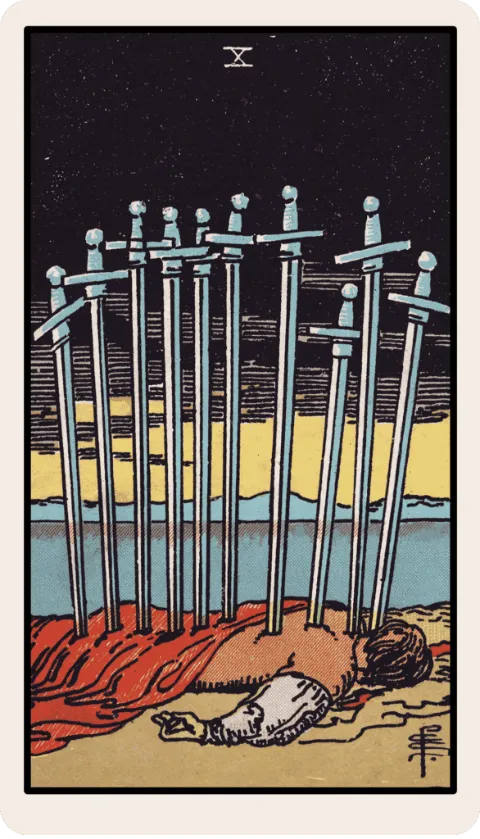
Ten of Swords in a nutshell
- Suit: swords, the suit of air, thought, language and truth.
- Upright: an ending, rock bottom, a betrayal completed, the drama over.
- Reversed: slow recovery, or an ending refused and dragged on.
- Element: air gone still, the silence after the storm has said everything.
- Yes or no: no; this chapter closes so the next one can open.
Ten of Swords upright meaning
Upright, the Ten of Swords is the ending with nothing left to negotiate. A job, a relationship, a version of yourself, a long fight: whatever it was, it is over, and the card spends all ten swords making sure you stop checking for a pulse. Hidden inside the melodrama is the mercy of the floor. Nothing more can be taken, the counting of losses can stop and the learning can begin.
Sometimes there is betrayal in it, discovering that a door you trusted was open to the weather all along. Just as often the wound is simple exhaustion: a situation that died of being unsustainable. Either way, look where the light is. The dawn in this card is not a metaphor added by kind readers; it is painted there, already arriving.
Ten of Swords reversed
What changes when it comes out reversed
Reversed, one of two things is happening. Either you are sitting up and pulling the swords out one at a time, the slow, genuine recovery that never looks cinematic, or you are refusing the funeral: reopening the argument, re-reading the messages, keeping a finished situation on life support. The first deserves patience. The second is costing you the dawn.
The reversal also warns against relapse right at the finish line, going back for one more round with the thing that flattened you. Honour the ending you already paid for. If it helps, write the last line yourself: what ended, what it taught, what travels with you. Then leave the beach.
Ten of Swords in love
In love, upright, the relationship as it was is over, and the card is firm about the phrase as it was. Some couples meet this card and separate; a few meet it and bury a dynamic, jealousy, silence, score-keeping, and start again inside the same names. If you are single, it often marks the real end of an old heartbreak, closure that finally holds, the ex-shaped ghost losing its lease.
Reversed, watch for the bond kept technically alive, the on-again lane where nobody is happy but nobody signs the ending. Every resurrection costs more than the last and pays out less. Alternatively, and more kindly, the reversal can mark healing that begins the day you stop re-reading the last chapter. You will know which one is yours by whether your mornings are getting lighter or just later.
Ten of Swords in work and money
At work this is the project cancelled for good, the layoff, the client lost, the burnout that ends an era, and the strange spaciousness that follows once the worst has actually happened. The field is clear now; build on it. Update the profile, make the calls, let the ending be public enough to bring you the next thing. With money, cut the losing position fully instead of bleeding slowly, close the account, end the subscription trap, and stop paying rent to the loss. Bottoms are only useful if you push off them.
How to read Ten of Swords in a spread
In the past position it is the collapse that explains your current caution; it earned you the caution, but not a life sentence of it. In the present it says let it end, stop administering the situation and let it finish. In the future it gives fair warning that something is completing, which is the gift of time to pre-grieve and to plan the morning after. Next to The Sun the recovery is generous and closer than expected. With the Ace of Swords the cycle restarts: out of the ending comes one clean, new idea. Beside Judgement the ending is also a verdict, and it frees you.
Frequently asked questions
Is the Ten of Swords a yes or a no?
A no. The situation you are asking about is closing, and the card advises against CPR. The better question is what to carry out of it, and on that one this card is unexpectedly generous. For a one-card answer to the next question, try the yes or no tarot.
What does the Ten of Swords mean as the card of the day?
Something small concludes today: a thread, a task, a low-grade conflict, a hope you were keeping on a drip. Close it cleanly and resist the urge to resuscitate it by evening. Endings handled well are strangely energising, and tonight you will sleep better than the drama predicted.
Does the Ten of Swords always mean betrayal?
No. Betrayal is one of its costumes, and the cards around it will say whether that one applies. Most of the time it simply means completion: a cycle spent to its last coin, usually by exhaustion rather than treachery. The ten swords measure how thoroughly it ended, not how many enemies you have.
Keep learning
Previous card: Nine of Swords. Next card: Page of Swords. You can also browse the full tarot card index or pull your tarot card of the day.
Tarot Vera Luna is an entertainment site: no reading replaces medical, legal, financial or psychological advice. Read this card in Spanish.